Kurztitel: AlcoFuels
IGF-Projekt-Nr.: 01IF00419 C
Projektlaufzeit: 07/2025 – ongoing
Fördergeber: CORNET/BMWE/IGF - Federal Ministry for Economic Affairs and Energy / Industrial Collective Research / International


The project involves experimental and numerical investigation of the fuel injection process, especially cavitation and spray formation, of methanol in neat form and in mixtures with (salt) water, engine oil, and additives, as well as the impact on erosion.
Renewable methanol is one of the most promising fuels for CO2-neutral applications, especially in the marine sector for large engines. The fuel properties as a neat substance or in the mixture with ethanol, petrol, and water have a significant influence on the fuel spray resulting from injection and thus the mixture formation and emission generation, as well as on the cavitation and erosion behaviour in the nozzle. A basic understanding of cavitation, spray and mixture formation processes with methanol and its blends is investigated.
A combined experimental/numerical approach is conducted with an industrial injector as well as the ECN Spray D model injector, with the aim of investigating the interactions between cavitation and flow. The experimental part of the research project will be carried out at the Chair of Fluid System Engineering at Friedrich-Alexander-University Erlangen-Nürnberg, while the focus of the Chair of Hydraulic Fluid Machinery (HSM) at RUB will be on in-nozzle and near nozzle flow simulations. Full spray and jet formation based on the data of RUB is simulated at the Institute for Simulation of reactive Thermo-Fluid Systems at TU Darmstadt. The numerical investigations are validated with experimental data. The combined experimental-numerical approach aims to investigate the interactions between cavitation and flow.
At HSM, a compressible solver based on the OpenFOAM framework is used for simulating in-nozzle flow. A post-processing toolchain is used for in-nozzle flow, nozzle-near spray, and erosion-sensitive wall zones. The nozzle-near spray field is validated based on Friedrich-Alexander-Universität (FAU) measurements. We provide suggestions for a more erosion-resistant design and operation of injectors. A novel seamless and validated description of the whole process chain of maritime methanol injection from in-nozzle flow to mixture formation is generated by the integration and combination of advanced optical and numerical methods. The use of an industrial and an academic injector ensures maximum dissemination and relevance to the scientific community as well as industry.
Ansprechpartner: Romuald Skoda
Copyright © HSM 2026
Letzte Änderung: 29. Jul. 2026
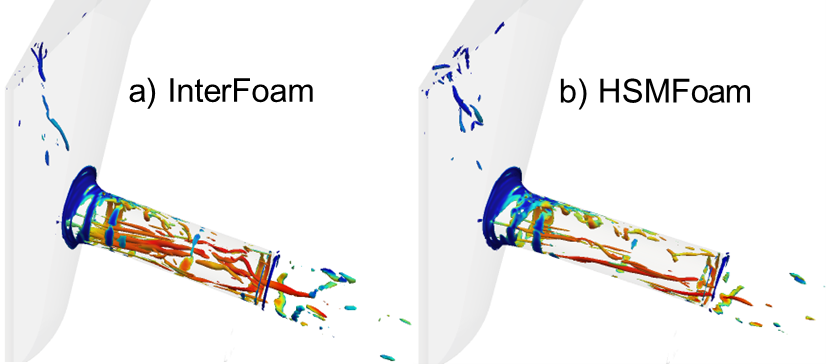
![<b>Figure 1: </b>Vortices by isosurfaces of 𝑄-criterion (𝑄 = 4.0e13 s−2) colored by magnitude of velocity (‖𝒖‖ ∈ [0, 600] m∕s) using a) InterFoam and b) In-house HSMFoam solver.](/hsm/mam/images/grafik/forschung/fittosize_1078_0_199_88_399fc71492ea7ce21933ae051fe6cc65_alcofluels_vortices.png "<b>Figure 1: </b>Vortices by isosurfaces of 𝑄-criterion (𝑄 = 4.0e13 s−2) colored by magnitude of velocity (‖𝒖‖ ∈ [0, 600] m∕s) using a) InterFoam and b) In-house HSMFoam solver.")