
Projektlaufzeit: 2026 – laufend
Projekt-Nr.: SK 243/1-2
Fördergeber: Deutsche Forschungsgemeinschaft (DFG)

In hydraulic systems, fluid mixtures e.g., hydraulic oils or fuels are utilized. These mixtures consist of several distinct components whose fluid and transport properties depend on the local mixture composition. In preliminary work it was shown by 1D CFD simulations on spherical single bubbles that for bubble dynamics additionally to air release, a local fuel segregation of the light- and heavy-volatile components within as well as around the bubble occurs, similar to droplet evaporation. This segregation is most pronounced in the presence of a high amount of heavy-volatile species and considerably effects bubble growth, which was traced back to species interdiffusion and its effect on evaporation mass and latent heat flux.
By a first version of a 3D method assuming a homogeneous mixture, local segregation was also observed on a high-pressure fuel injector, as shown by Figure 1. For this 3D method, sub-grid scale models for local species interdiffusion and cavitation-induced air release will be developed in this project proposal. Therefore, considering all transport processes and first order principles, the mathematical model of the 1D single bubble method will be adopted to a phase interface-resolving 3D volume-of-fluid method and applied to bubble clusters. In preliminary work, this 3D volume-of-fluid method has already been applied for interface-resolving flow simulations of single droplets suspended in a homogeneous isotropic turbulent flow, as shown by Figure 2. From the bubble cluster reference results, sub-grid scale models will be derived, integrated into the homogenous mixture approach and validated on a planar diffuser as well as high pressure injector, including primary breakup. The resulting 3D multi-component cavitation model enables a considerably more accurate simulation of cavitating flow in fluid mixtures, than is feasible with recent single-component surrogate fluids.
Ansprechpartner: Mario Hermes
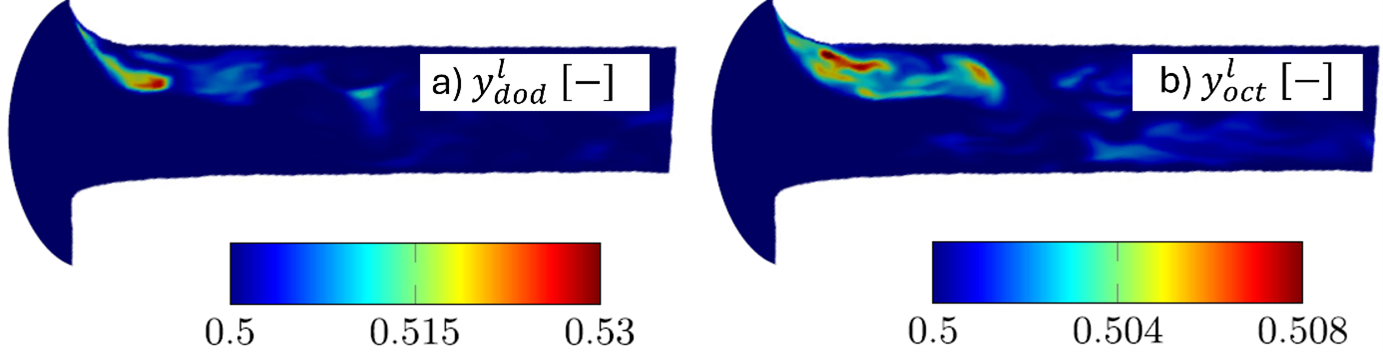
Figure 1: Partial mass fraction of the heavy-volatile component in a 50/50 % dodecane/heptane mixture (a) and in an octane/heptane mixture (b).
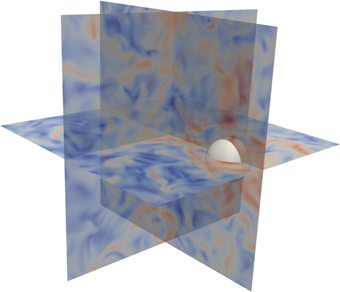
Figure 2: Single droplet suspended in a turbulent flow
Copyright © HSM 2026
Letzte Änderung: 29. Jul. 2026
